In his article, “The Poet: Bill Evans,” Gene Lees commented:
Bill managed to blend in his playing sophisticated methods with a trusting youthful emotionality, almost like the music of Grieg. I was discussing Grieg with Bill once, specifically the lovely Holberg Suite. “I went through a phase of pretending I didn’t like Grieg,” I said. “So did I,” Bill said. And, anticipating his answer, I said, “I know what happened to me, but what happened to you?” “The intellectuals got to me,” he said.
Apparently, Bill was able to rebuff the criticism put forth on Grieg by the “intellectuals.” As we continue to examine “Peace Piece,” notice the continued open-5th motion in the right hand. This is evocative of Grieg’s “Klokkeklang” as seen below:
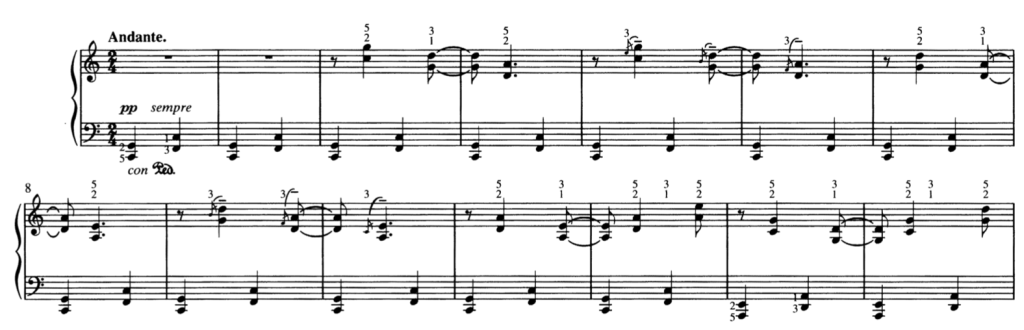
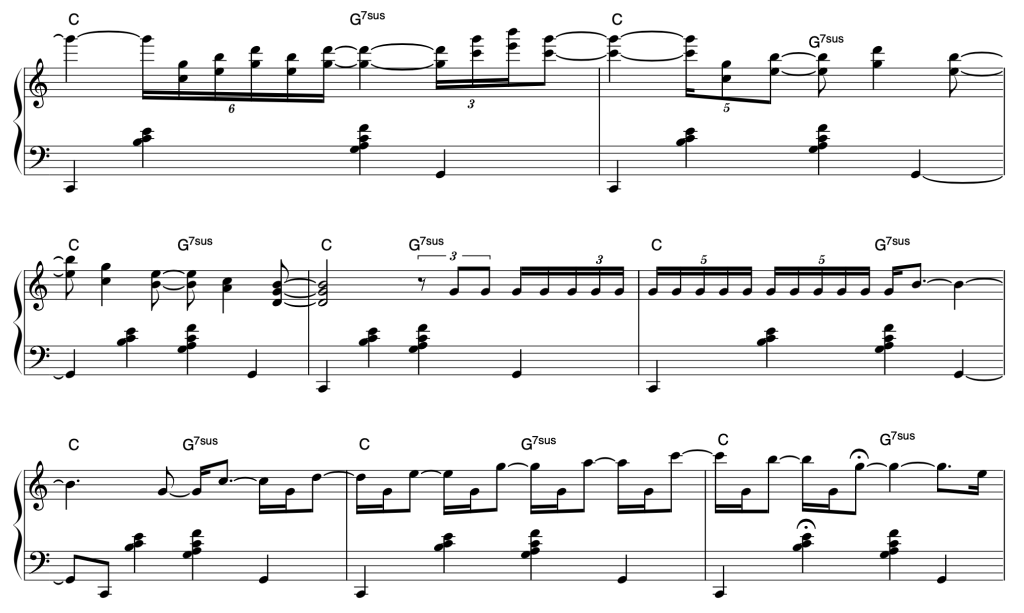
As we return to “Peace Piece,” take note of how Evans breaks up the next eight measures into three thematic strains. Firstly, he continues the use of the perfect fifths in the right hand against the steady accompaniment. However, each statement is varied: the ultimate sixteenth notes of a sextuplet are tied to a quarter note, syncopating the motion; the third beat is then tied to the first sixteenth note of a triplet figure, which again offsets the stress of the line; on the “and” of beat four of the first measure of this section, Evans uses an open-fifth of C6-G6 as an anticipation that is carried over to the downbeat of the next bar. While the bass line continues to vacillate between the tonic and dominant, Evans manipulates the right hand figures with more syncopation: a quintuplet grouping propels the rhythm forward, which creates a subtle jauntiness as the strong beat is concealed with the tied open-fifths of the E5-B5. He employs this rhythmic play (eighth note-quarter note-eighth note, reminiscent of the Grieg example above) for the remainder of the bar and through the third measure.
The second motive begins in the fourth bar of this section. With a single repeated noted, G4, Evans displaces the simple meter with two triplet groupings followed by two quintuplets. This propels the piece to the third theme.
In order to break up the repetitive second motif, Evans uses an ascending figure that centers around the dominant. The melody begins on the third beat of the fifth bar of the excerpt. First, he states a rising major 3rd from G4 to B4. The sequence continues with oblique motion through a perfect fourth, perfect fifth, major sixth, and reaches its apex at the compound interval of perfect 11th. He then allows the melody to fall from A5, G5, and then E5, which leads to the subsequent tonic chord. Like the entirety of the example, Evans employs syncopation within this theme; the upper melodic line not only tends to fall on a weak part of a beat, but is tied to a strong beat, thus displacing the metric accent.
 This Quiet Fire