A halcyon, repetitive rhythmic figure in the bass, an ostinato, establishes the foundation. After a few measures, a simple melodic line is stated and eventually evolves into a succession of progressively intricate variations. The initial tonal center unravels as each subsequent, dissonant passage belies the tune’s opening stability. The impression of “Sturm und Drang,” or storm and stress, ultimately passes as the song returns to its opening theme. Peace has been restored.
While the above description may draw parallels to Frédéric Chopin’s Op.57, “Berceuse” and the adagio movement of Maurice Ravel’s Piano Concerto in G Major are common, the music is “Peace Piece” from Bill Evans’s second album as a leader, Everybody Digs Bill Evans (1958).
Evans, whose music is an amalgam of musical traditions, had an encyclopedic knowledge of the classical repertoire. Gene Lees, a close friend of the pianist, once wrote: “The poetry of Bill’s playing compels the comparison to Chopin, whose music, incidentally, Bill played exquisitely.” Composer Lalo Schifrin took the juxtaposition a step further when he maintained: “It was said in their own time that Liszt conquered the piano, Chopin seduced it. Oscar [Peterson] is our Liszt and Bill is our Chopin.”
Notwithstanding the homages to the classical masters, “Peace Piece” is a seraphic exposition from the mind and soul of a jazz musician. According to Evans’s producer at Riverside Records, Orrin Keepnews:
The second album was recorded very shortly after Bill left the [Miles] Davis band…that session deserves to be remembered because it saw the creation of “Peace Piece.” The strange story of how that came about: Searching at the piano to work up an introduction to the Leonard Bernstein show tune, “Some Other Time,” Bill found that he’d gotten into something he liked better than that song and went on to record his reflective, probably immortal improvisation.
The following transcription, with rights belonging to TRO – © Copyright 1965 (Renewed) Folkways Music Publishers, Inc., New York, NY International, illustrates the dichotomous nature of Evans’s masterpiece.
A six-bar introduction establishes the tonal center of C major with alternating tonic and dominant harmonies. The melody enters with an ascending leap of a perfect fifth (G4 to D5).
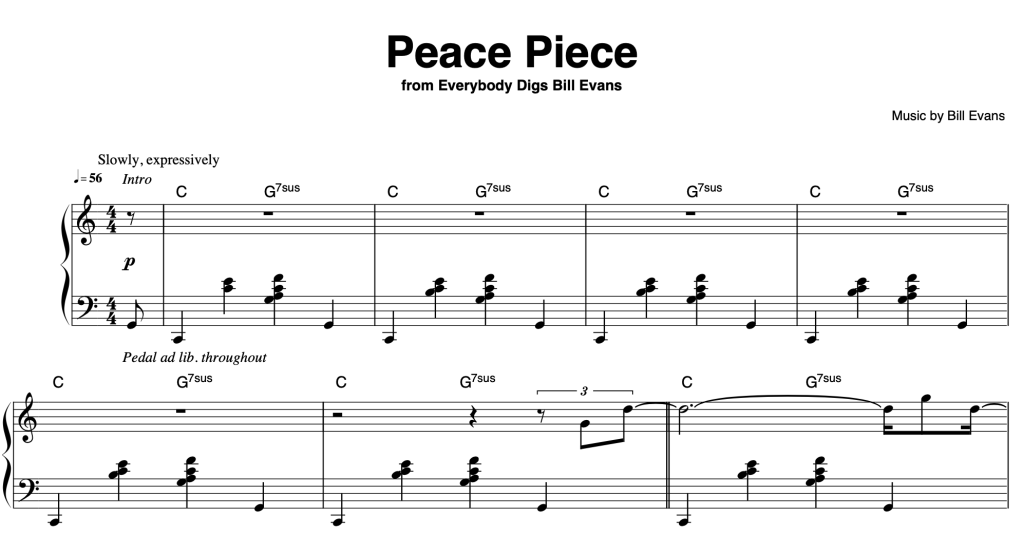

Evans crafts a tranquil melody based largely on chordal skips. Any dissonance is primarily relegated to appoggiaturas, suspensions, and anticipations; all pitches are diatonic. He continues this arpeggiated approach for bars 15-20 (below). Notice the contour of his improvisation — it rises and falls. As the line descends by thirds in m. 17, he adds a sforzando with the E5 and a continues with a slight crescendo for emphasis. Evans brilliantly provides a respite in m. 19 with only the hush of the accompaniment. This sets up a change in the texture in the right hand: rising, parallel perfect fifths that create a delicate soundscape and climb to the pitch G6; the sound is reminiscent of Chopin’s Mazurkas No. 6 and No. 7 where he employs this technique in the left hand. Debussy was also fond of this open quality and utilized it, largely in octaves in his masterpiece, Prélude à l’après-midi d’un faune.

Next time, we’ll examine how Evans pushes the boundaries of tonality as his improvisation unfurls.
Share this:
 This Quiet Fire